Tackling Challenging Anterior Restorations In Pediatric Teeth
Dr. Dusty Janssen discusses difficult anterior cases and more!
EZCrowns
Dr. Dusty Janssen was fortunate to be able to use all different types of crowns in residency and started using EZCrowns early on. He notes that with EZCrowns you can prep substantially less compared to other zirconia brands which preserves tooth structure. Strip crowns are another esthetic option he used during residency, but found they were not as strong. He notes that he was fixing a ton of strip crowns during residency and thought that there had to be a better way. Host Dr. Jarod Johnson says he was also introduced to EZCrowns during residency at UNLV and they are now the gold standard in his office for anterior restorations. They’re stronger, more biocompatible, and esthetic.
Challenging Anterior Cases
Some of the most challenging cases are those anterior teeth D-G on one to two-year-old patients. Parents usually have concerns about treatment at such an early age. Let’s say an eighteen-month-old kid presents with no pulpal involvement. Should you extract them? Use SDF and wait? And then have the patient come back and treat them with zirconia crowns?
Dr. Dusty notes that first and foremost the most important aspect is the child’s overall health. Ultimately, he likes to address the status of their health and assess anything that needs improvement – bad habits must change. Delaying general anesthesia (GA) if possible is a good idea. As a rule, Dr. Dusty Janssen does not use general anesthesia for any patients under two.
Does every zirconia crown need a pulp? No- Dr. Janssen notes that he doesn’t normally have to pulp a tooth because of the minimal preparation of EZCrowns. He uses SmartMTA when appropriate but not often. Instead, he uses SDF in most cases. Although he says that the SmartMTA is nice to use because of the strength, viscosity, and quick set time.
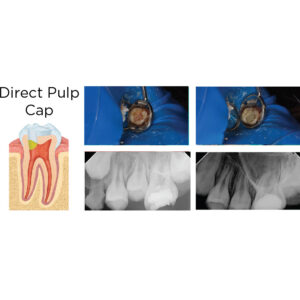
What if the tooth is too far gone, you haven’t done SDF, and you’ve done vital pulp treatment under anesthesia, with pulp exposure?
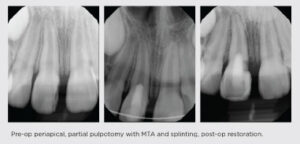
Dr. Janssen suggests using SmartMTA for a pulpotomy. He notes that studies show that there’s no difference in outcome between pulpotomies and pulpectomies in vital primary teeth.
Obtaining Hemostasis
What are some of the things to do for an atraumatic preparation?
Mastering the Sprig Accelerated Subgingival Atraumatic Preparation (ASAP) technique changed the game in hemostasis for him. Take your flame diamond bur and feather into the margin to hug the tooth and remove the ledge without getting into the tissue. Dr. Dusty notes how amazed he is by how little bleeding he gets and how healthy the tissue looks when he uses Sprig’s ASAP technique. He also likes using Traxodent if he’s using a paste because it’s thick enough to get down into the sulcus. You should get your cement to a putty-like consistency before seating the crown to displace the heme. He also uses HemeRx pellets, which works well to stop bleeding. Host Dr. Jarod Johnson uses a combination of direct pressure, ViscoStat, and HemeRX pellets.
Remember to achieve hemostasis before placing the crowns to prevent a grey color beneath your zirconia restorations. Dr. Johnson also suggests prepping the anterior teeth first and then coming back to place the crowns after taking care of any posterior needs. Dr. Janssen takes plenty of pictures, specifically those cases he has treated with SDF before placing zirconia over them. If there’s a black stain, he can show how much the tooth has improved since treatment. Host Dr. Jarod Johnson notes that taking pictures will help as a learning tool for tooth preparation. Pictures don’t lie. They give you validity as the treating doctor and builds confidence in parents in you as a provider.
Cements
Which cement do I choose?
Dr. Janssen uses Fuji1 Cem – a pure glass ionomer cement that bonds well to tooth structure. In the OR he uses Ketac Cement, a pure glass ionomer cement is more forgiving. He found that he doesn’t have any issues with the crowns coming off when he uses pure glass ionomer cement. RMGI doesn’t work as well because you lose the bond to the tooth in most environments.
The reason Host Dr. Jarod Johnson chose EZCrowns is because of Zir-Lock® technology. Whatever cement you choose to use will work. You won’t have to worry about bonding to the crown because of the mechanical retention, which allows you to focus on achieving hemostasis. In the OR, Dr. Johnson uses a high viscosity glass ionomer restorative as a cement.